

Rheotech - Naples Yellow (Hue)
Customers praised the paint's thick consistency and excellent coverage. Shoppers described it as "thick beautiful paint" with "beautiful coverage," indicating high satisfaction with the product's quality and performance.
Purchased Tri Art violet and other colours in the same line, hoping to support Canadian with my teaching paint - incredibly disappointed, the pigment load is a joke, and I am comparing it to other student line paints!
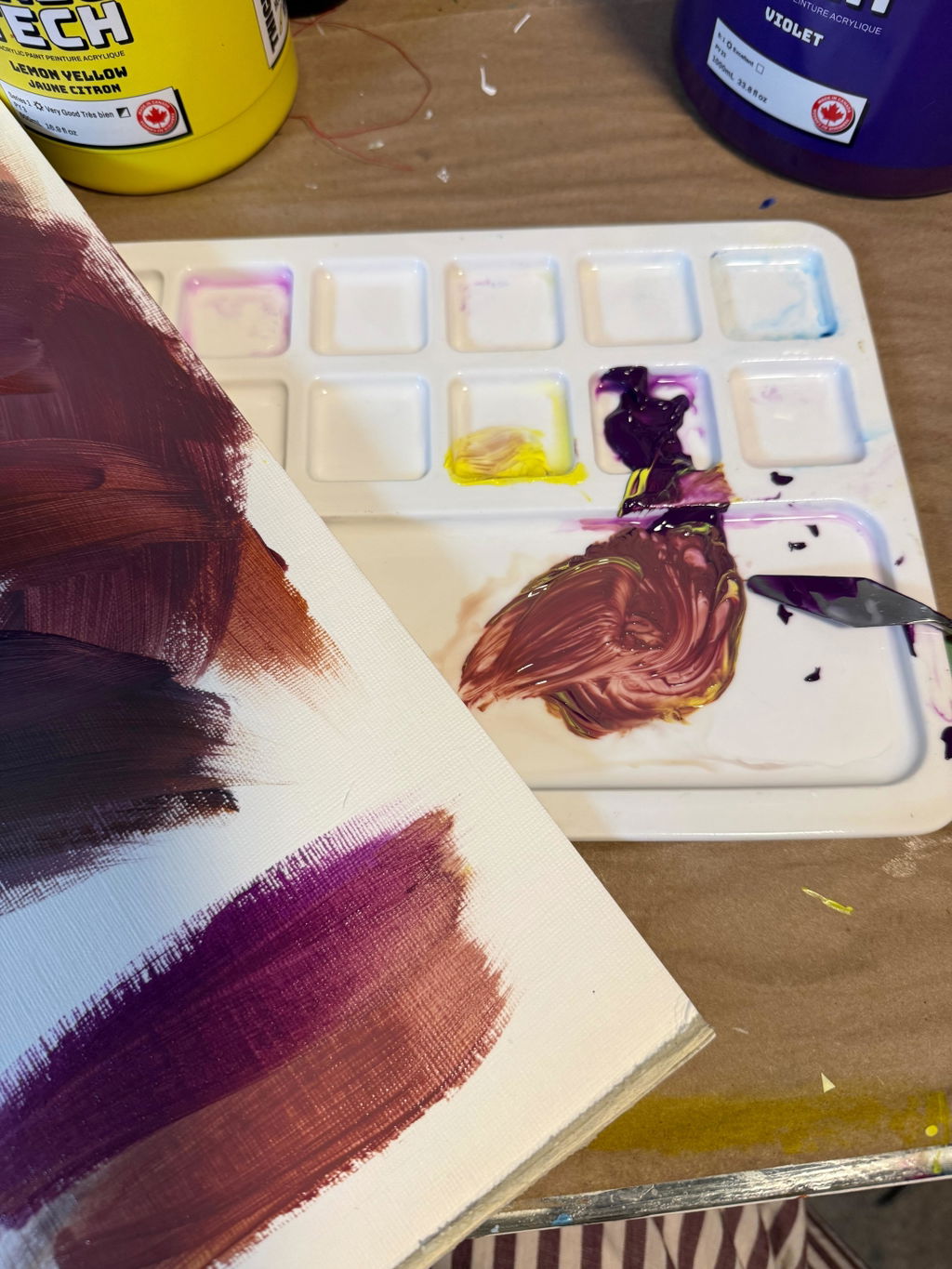
Photo attached of the mixing power of this paint, with lemon yellow from the same line.
Texture/body workability is fine. But let’s be honest: pigment load for this colour is comparable to dollarstore paint.
I don’t like leaving reviews like this. I’m sorry.
Thanks so much for trying our paints and for supporting a Canadian maker. We’re sorry the mixes didn’t match what you expected.
Our Violet is Dioxazine Violet (PV23): a very transparent, extremely high-tint pigment. Our Lemon Yellow is a green-shade yellow (PY3). These two are near-complements, so even a tiny touch of PV23 will rapidly neutralize PY3 into olives/khakis and grey, often reading as “weak” colour even though tint strength is high. The photos you shared look consistent with that behaviour, so the colour mixing is actually what you would expect.
If you’re aiming for richer browns/warmer neutrals, pair Violet with a warmer, more red-leaning yellow or add a bit of red oxide. For a quick self-check of strength, compare 1:10 white tints; PV23 will show very strong colouring and pigment loading. If the issue is a lack of opacity, there is often a misconception that opaque colours have higher pigment loading, and transparent colours have low pigment loading. This is a falsehood, transparent colours can be highly tinting, with very high pigment laoding, which can be ideal for glazing techniques and some colour mixing. It depends mostly on the pigment itself and on how the pigment is ground and dispersed.
Beautiful paint just love them. Affordable and made in Canada 👍
Rheotech - Pastel Yellow
The colours are stunning and the consistency is perfect for me. I highly recommend them, especially for beginners like me. Thank you guys so much!
I’m very new to acrylic painting. Rheotec is a great quality paint especially compared to other student brands I’ve tried. It’s my number 1 go to paint!
No more to say
I was needing a cobalt green like TriArt has but Rheotech doesn't, ...so I tried the turquoise. It's a pretty colour but not what I wanted
very pigmented, great for beginner acrylic artists and experienced artists. Very good for prepping the canvas as well.
Although Rheotech is a student grade paint it performs like a professional grade - surprisingly. I use it for large poster size illustrations and experimentations.
An essential for tinting and mixing and sometimes overlooked for its true value that it adds to ones palette. I really like the Rheotech line of acrylics.
Rich vibrant colour.
Ok
Was fine
Spreads well, very well pigmented
Outstanding quality and value!
Happy to support a great Canadian company that has outstanding products!
Wonderful colour, smooth for painting! Love the products.
Rich vibrant colour. Tri-Art products are amazing.
Fantastic.
Quite pleased with the Burnt Umber. I use it a lot in my under paintings. These paints have a clean odour to them as well which I appreciate.
Excellent. Simply excellent.
Really, really great!
Great product! As always Tri-Art delivers.
Very,very nice paint.
Rheotech - Cadmium Red Medium (Hue)
Great!
Trying some new paints. I have been using the same brand for ten years. Ordering was flawless.
No contamination in the paint. Pure pigment which is absolutely needed.
And bonus, love the price!!!
Good paint
Rheotech - Chrome Oxide Green
I love the creamy texture of these Rheotech paints. I've been using them on paper, in my sketchbook and on gessoed panels and they work well on all of these surfaces.
About Acrylic Paint
This explains what acrylic paint is, and why our acrylic films are dependable over time.
What acrylic paint actually is
Acrylic paint is pigment dispersed in an acrylic polymer emulsion. As water evaporates, the acrylic particles coalesce into a continuous, flexible film that locks pigment in place and adheres to the surface.
Our binder and manufacturing approach
Tri-Art paints are 100% acrylic polymer emulsion products. We manufacture using a custom high-solids acrylic resin, and this binder standard applies across our range, including professional and student quality.
Using water confidently
Because our acrylic films are built on a high-solids acrylic resin system, artists can be more comfortable using water as a working medium without feeling like they are automatically compromising film integrity. For very thin applications, build in controlled layers and let each layer dry before continuing.
Practical tip: if you are creating extremely thin washes for extended areas, consider alternating thin layers with normal-strength layers to maintain a robust film build.
Viscosity
Rheology

Flip it or unscrew it.
Your Tri-Art tube has a dual-function cap — flip open or unscrew for use.
Getting the most from every Tri-Art tube
Your cap has two modes — here is how and when to use each one, plus a few habits that make a real difference.

Flip open
Use the flip function during an active session. It lets you access paint quickly without fully removing the cap, which keeps threads cleaner and speeds up your workflow.
Note: If the flip hinge ever breaks with use, simply rest the cap back on the tube and use it as a standard screw cap going forward. The tube works perfectly either way.

Screw open
For overnight or longer-term storage, screw the cap down fully to create a complete seal. Firm contact is all that is needed — over-tightening is a common cause of cracked caps.
Three habits that make your tubes last
-
01
Wipe the nozzle before you cap it. A quick wipe with a damp cloth — threads and cap interior — takes five seconds and is the single most effective thing you can do. Acrylic cannot bond two surfaces if it never dries there.
-
02
Use the flip cap during active sessions. Reduces thread contact and keeps the seating surface cleaner between each squeeze.
-
03
If a cap has stiffened, use warm water. Hold the nozzle under warm running water for 30 to 60 seconds. The moisture softens dried paint at the threads enough to break free without forcing anything. Do not use boiling water.


