
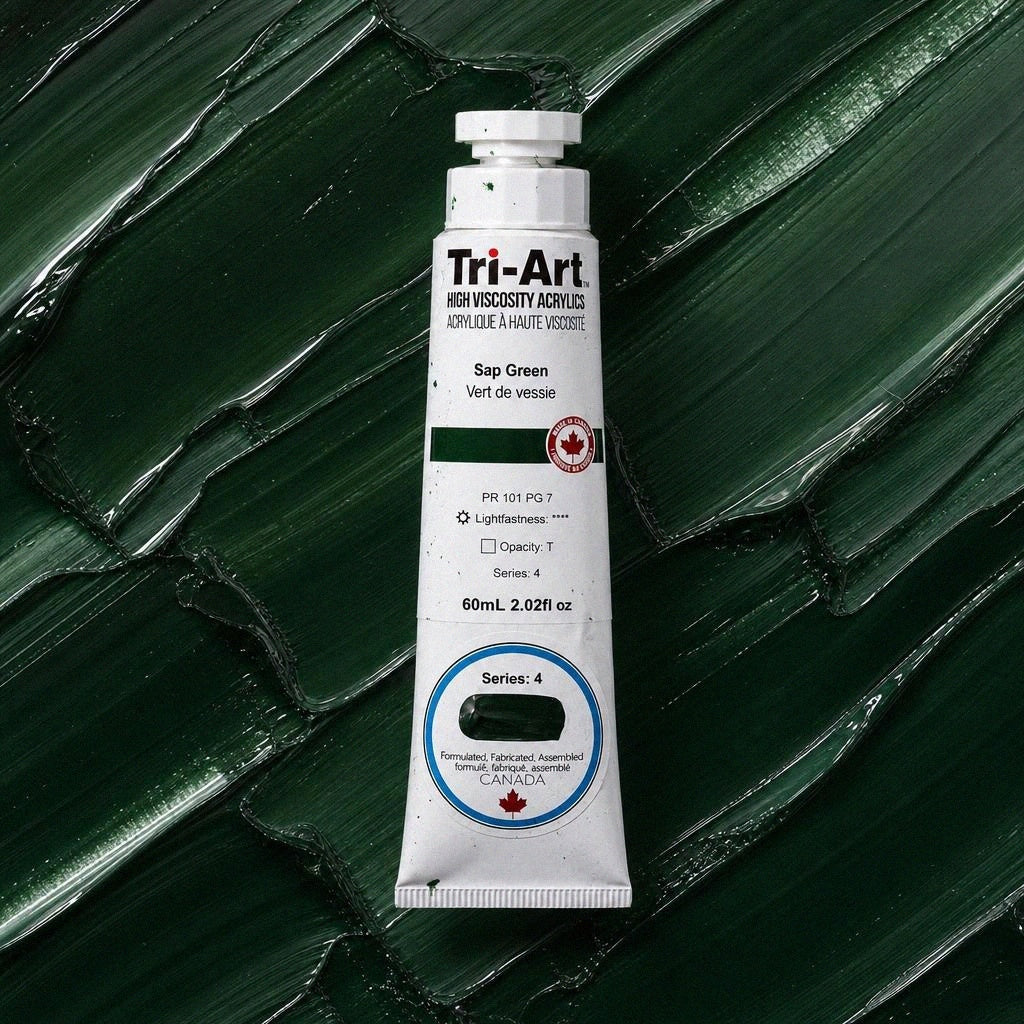
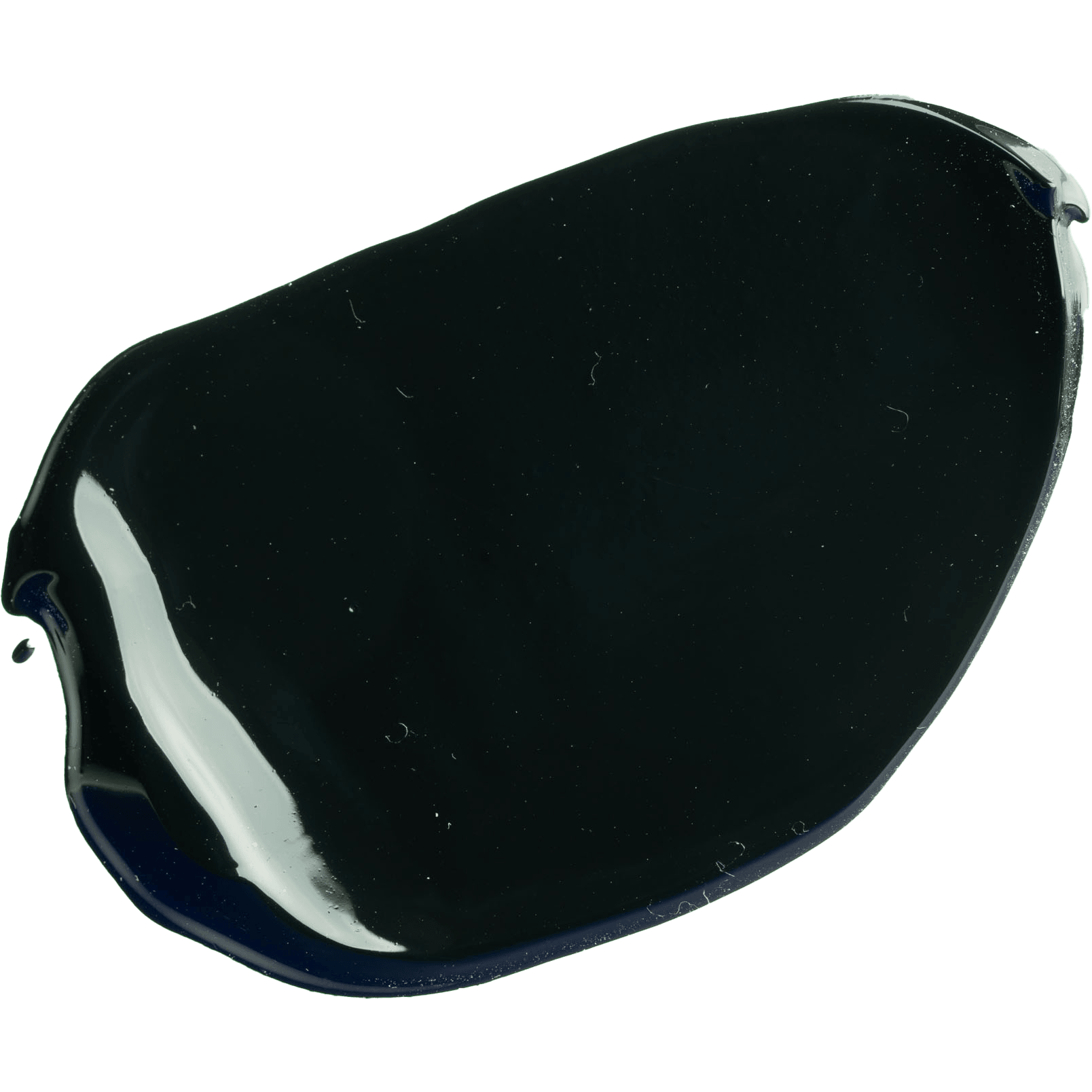
Tri-Art High Viscosity - Sap Green
Technical Information
Description
Sap Green is part of Tri-Art High Viscosity Professional Acrylic Paint, a heavy body acrylic with a thick, buttery consistency that holds brushstrokes and palette-knife texture. Built with high pigment loading and a fine grind, it stays bold and clean for impasto, scumbling, and confident brushwork.
Pigment profile: Mixed pigment colour (PG7, PR101). Bias: Warm. Pigment family: Mixed. Transparent handling, excellent for glazing, optical layering, and deep colour mixes. Medium tinting strength, mixes predictably across a wide range of palettes. Full staining, tends to leave a stronger stain in thin films and glazes. Lightfastness rating: 4. Sheen: Gloss. Granulating pigment character, can show beautiful texture and break in thin passages.
- Pigments: PG7, PR101
- Formula: Mixed
- Opacity: Transparent
- Colour bias: Warm
- Lightfastness: 4
- Sheen: Gloss
- Tinting: Medium
- Staining: Full
- Special trait: Granulating
Pigment notes: A staple of academic paint palettes, this pigment was originally extracted from Buckthorn Berries. The initially purple juice went vivid green when mixed with alkaline solutions.
Great for: Academic (Student), Old Master, Glazing, Mixed.
About Acrylic Paint
This explains what acrylic paint is, and why our acrylic films are dependable over time.
What acrylic paint actually is
Acrylic paint is pigment dispersed in an acrylic polymer emulsion. As water evaporates, the acrylic particles coalesce into a continuous, flexible film that locks pigment in place and adheres to the surface.
Our binder and manufacturing approach
Tri-Art paints are 100% acrylic polymer emulsion products. We manufacture using a custom high-solids acrylic resin, and this binder standard applies across our range, including professional and student quality.
Using water confidently
Because our acrylic films are built on a high-solids acrylic resin system, artists can be more comfortable using water as a working medium without feeling like they are automatically compromising film integrity. For very thin applications, build in controlled layers and let each layer dry before continuing.
Practical tip: if you are creating extremely thin washes for extended areas, consider alternating thin layers with normal-strength layers to maintain a robust film build.
Viscosity
Rheology

Flip it or unscrew it.
Your Tri-Art tube has a dual-function cap — flip open or unscrew for use.
Getting the most from every Tri-Art tube
Your cap has two modes — here is how and when to use each one, plus a few habits that make a real difference.

Flip open
Use the flip function during an active session. It lets you access paint quickly without fully removing the cap, which keeps threads cleaner and speeds up your workflow.
Note: If the flip hinge ever breaks with use, simply rest the cap back on the tube and use it as a standard screw cap going forward. The tube works perfectly either way.

Screw open
For overnight or longer-term storage, screw the cap down fully to create a complete seal. Firm contact is all that is needed — over-tightening is a common cause of cracked caps.
Three habits that make your tubes last
-
01
Wipe the nozzle before you cap it. A quick wipe with a damp cloth — threads and cap interior — takes five seconds and is the single most effective thing you can do. Acrylic cannot bond two surfaces if it never dries there.
-
02
Use the flip cap during active sessions. Reduces thread contact and keeps the seating surface cleaner between each squeeze.
-
03
If a cap has stiffened, use warm water. Hold the nozzle under warm running water for 30 to 60 seconds. The moisture softens dried paint at the threads enough to break free without forcing anything. Do not use boiling water.


